
Ambassador Work for a Mining Pool: What the Role Actually Involves
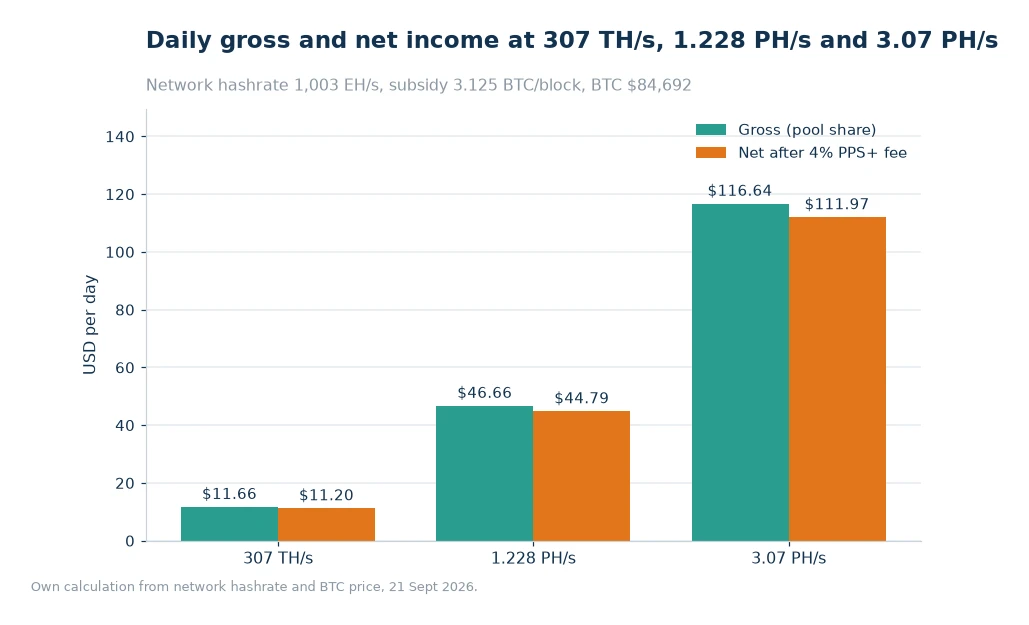
An ambassador role is a teaching job with a referral code attached. The people who do it well spend most of their time explaining payouts, difficulty and power bills to miners who have never read a fee schedule. One 307 TH/s machine credits 0.00013772 BTC a day, or $11.20 after the listed 4% at $84,692 per coin, and that single figure answers more beginner questions than any slide deck.
Key takeaways
- At 307 TH/s the credit is 0.00013772 BTC a day, or $11.20 net of the listed 4%.
- Ten such machines reach 3.07 PH/s and $116.64 gross a day, which is the scale most groups ask about.
- The role is education first: payout schemes, settlement timing, wallet flows and power cost.
- Applications go through Apply for Ambassador, and rewards are set by the program rather than by the article.
The job in one paragraph
An ambassador is the local face of a global service. That means answering questions in the language miners actually use, running sessions where a dashboard is projected on a wall, and being reachable when somebody's payout looks wrong at eleven at night. It is not a sales quota in disguise, and the people who treat it as one tend to burn out in a quarter, because mining communities are small and reputations travel faster than referral links.
The technical part is narrower than it sounds. Most questions fall into four buckets: how a payout scheme settles, why the daily number moved, where the coins go after they are credited, and whether a given machine can cover its power bill. Get comfortable with those four and the rest is logistics.
Why a pool needs local voices
A service used in 150+ countries by more than a million people cannot answer every question from one support desk in one time zone. Local advocates fill that gap: they know which exchange is used in their market, which hosting provider is reliable, and which grid charges what. They also know which questions are polite and which ones a newcomer is too embarrassed to ask.
That last point is underrated. A miner who does not understand why PPLNS paid nothing for two days will often leave rather than ask. An ambassador who explains the 6-confirmation wait and the 5-round window before it happens keeps that miner in the ecosystem, which is worth more than any single referral.
The program and the referral layer
The ViaBTC Ambassador Program is the formal route: an application, a review, and a set of expectations about what an ambassador publishes and supports. The ViaBTC Referral link is the separate, lighter mechanism that any account holder can use. They overlap in practice, since a good ambassador will inevitably bring new miners, but they are not the same thing, and mixing them up in a pitch is the fastest way to sound unprepared.
Read the program terms before promising anything to a room full of people. Reward structures change, and an ambassador who quoted yesterday's terms last month has to walk them back in public. It is better to say that the program sets the terms and point to the application page than to improvise a number that later turns out to be wrong. Apply for Ambassador when the audience is real, not before.
The arithmetic your audience will ask about
Sooner or later somebody asks what a machine actually earns, and the answer needs to be arithmetic rather than enthusiasm. Take 307 TH/s as the unit. Four of them make 1.228 PH/s, ten make 3.07 PH/s, and output scales in a straight line because network difficulty does not care who owns the hardware. The table holds price and difficulty at the 21 September 2026 reading.
| Machines | Total hashrate | BTC per day | Gross USD |
|---|---|---|---|
| 1 | 307 TH/s | 0.00013772 | $11.66 |
| 4 | 1.228 PH/s | 0.00055089 | $46.66 |
| 10 | 3.07 PH/s | 0.00137722 | $116.64 |
The column that ends the argument is the one that is not there: power. At $0.06 per kilowatt-hour, a 307 TH/s machine drawing 20 joules per terahash consumes about 147 kWh a day, or $8.84. That leaves roughly $2.36 of the $11.20 net credit. In a market where power costs $0.10, the same machine is underwater before the fan spins up. Teaching that comparison is the whole job in miniature.
Worked example
Run the numbers on stage, slowly, because the point is the method.
- Network output: 3.125 BTC × 144 blocks = 450 BTC a day.
- Output per TH/s: 450 ÷ 1,003,107,267 = 0.000000448606 BTC.
- At 307 TH/s: 307 × 0.000000448606 = 0.00013772 BTC.
- In dollars: 0.00013772 × 84,692 = $11.66.
- After the listed 4% on the block-reward component: 11.66 × 0.96 = $11.20.
- Power at 20 J/TH and $0.06/kWh: 307 × 20 = 6,140 W, × 24 = 147.4 kWh, × 0.06 = $8.84.
- Margin before hosting: 11.20 − 8.84 = $2.36 a day.
That is the shape of every honest conversation about mining. The gross figure looks generous, the net figure after the listed rate looks fine, and the margin after power is the one that decides whether the machine stays plugged in. An ambassador who can produce those three lines for any hashrate is more useful than one with a better presentation.
What to bring to an application
Three things carry more weight than a follower count: evidence that you already answer mining questions in public, a clear idea of which audience you reach, and a realistic sense of how much time you can give. A moderator of a regional mining chat with two hundred active members is a stronger candidate than an account with a large but silent following. The program is looking for reach that converts into informed users, not reach that converts into impressions.
Prepare one demo you can run without wifi. A printed payout table, a worked example at a common local hashrate, and a short explanation of how coins move from the pool to a wallet will cover most of the questions you will face in the first month. Add a link to the App for iOS and Android so newcomers can watch their own hashrate instead of asking you every evening.
A first month that does not collapse
Run three sessions rather than ten. The first explains accounts, wallets and why a payout address is not an email address. The second walks through PPS+ and PPLNS with real numbers, including the fact that PPLNS can pay nothing for a day and then pay more. The third is a clinic: bring a laptop, project a dashboard, and debug real accounts with permission. That sequence produces competent miners, and competent miners stay.
Keep a written FAQ as you go. Every question you answer twice belongs in it, and the document becomes the thing you hand to the next person who joins. It also protects you from repeating a half-remembered explanation, which in this field is how myths about fees and payouts spread.
Frequently asked questions
Do I need to run a mining farm to become an ambassador?
No. The role is about explaining payouts, difficulty and power cost to a local audience, and a moderator who can work through a 307 TH/s example clearly is more useful than an operator who cannot.
Is the ambassador program the same as the referral link?
They are separate: the program is a reviewed role with its own expectations, while ViaBTC Referral is a link any account holder can share, and many ambassadors use both.
What should I teach first at a local session?
Start with the credit at a familiar hashrate, such as 0.00013772 BTC a day at 307 TH/s and $11.20 after the listed 4%, then subtract power before discussing hardware.
Start with one room, not one campaign
Pick the smallest useful format: six miners around a table, one laptop, one printed table of credits at the hashrates they actually own. Answer the payout question honestly, including the parts that are unflattering, and let the referral link do its work afterwards. Ambassadors who begin with a room tend to still be there a year later; the ones who begin with a launch post usually are not.
The ViaBTC App is the handout to end on, because it turns your explanation into something each miner can check alone. Show the hashrate graph, show where the daily credit appears, and tell them what a normal bad day looks like. Setting that expectation early is the difference between a support question and a departure.
Sources: the ViaBTC ambassador, referral and app pages for program scope and tools[1]. Chain data read 21 Sept 2026: network hashrate 1,003 EH/s, difficulty 132.76 T, 3.125 BTC per block, 144 blocks a day, BTC $84,692. Published 22 Oct 2026; power costs are illustrative and vary by market.