
Turning a Scent Museum Visit Into Retail Brand Assets, Step by Step
A museum visit is only worth the travel if it produces something that survives the trip. For a drugstore own-brand range, that something is rarely a photograph of a beautiful room. It is a set of assets: a shelf story, a staff one-pager, training material, a short video and a packaging narrative, each of which has a named owner and a place it will be used. The process below turns a single visit into that set, and it starts before anyone leaves the office.
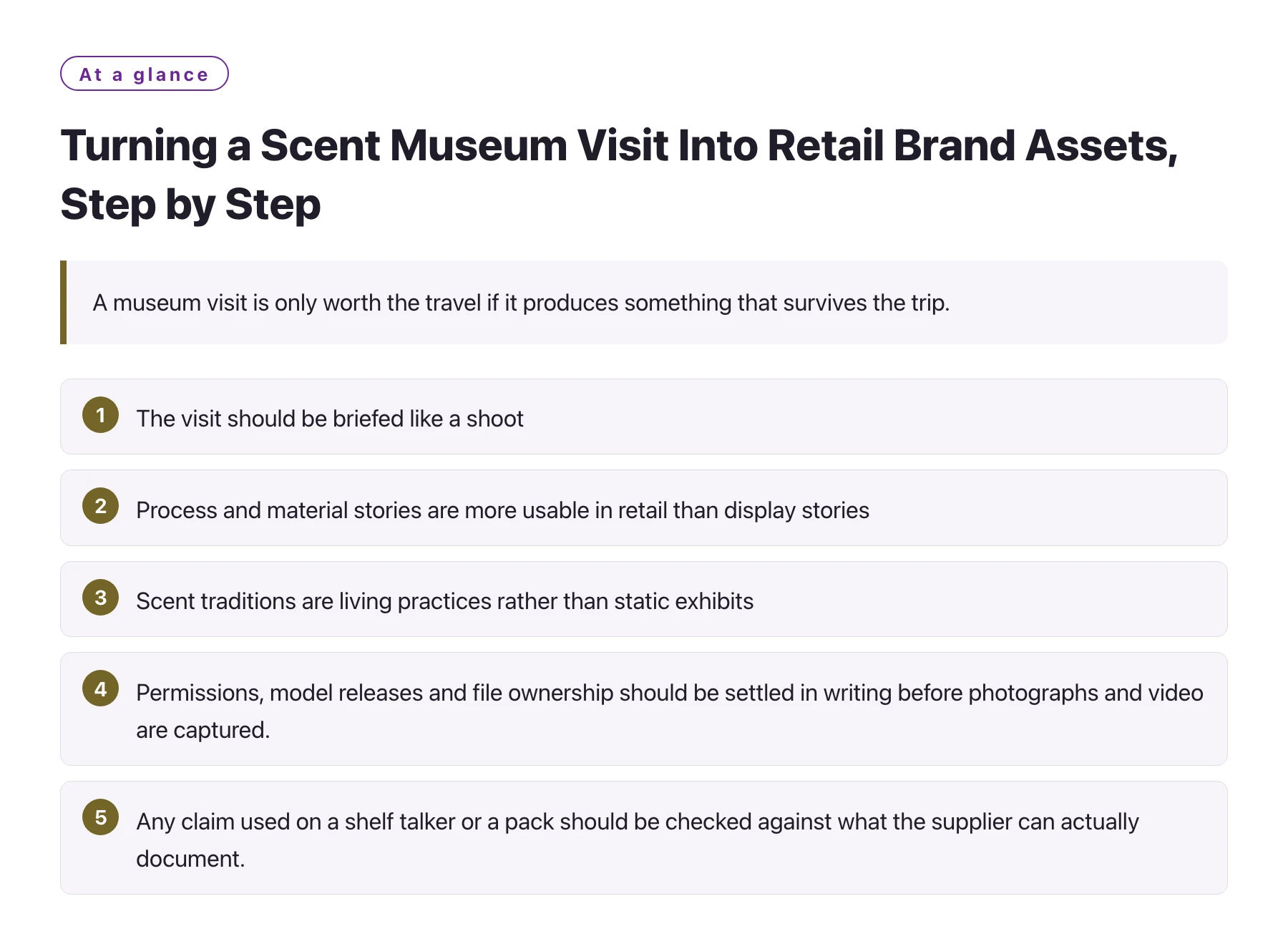
Key takeaways
- The visit should be briefed like a shoot, with the assets named in advance rather than discovered afterwards.
- Process and material stories are more usable in retail than display stories, because they explain where the product comes from.
- Scent traditions are living practices rather than static exhibits, and presenting them as heritage rather than as decoration is what makes a retail story credible [1].
- Permissions, model releases and file ownership should be settled in writing before photographs and video are captured.
- Any claim used on a shelf talker or a pack should be checked against what the supplier can actually document.
- Consumer trend research is a useful place to test whether a provenance story is landing with shoppers before it is printed [2].
Retail brand teams are asked for content constantly. The demand comes from the shelf, the website, the social calendar and the training programme, and it is usually met by the same small group of people. A museum visit looks like an efficient way to feed all four at once, and it can be, provided the visit is planned as production rather than as a trip.
The planning matters because the cost of a bad visit is not the ticket. It is the wasted day, the unusable photographs, and the meeting afterwards in which everyone remembers that the room smelled nice but nobody can remember which material was which.
What follows is a six-step process, followed by the assets worth capturing and the claims worth avoiding.
The six-step process
- Name the assets before bookingA shelf talker line, a staff one-pager, four social images, a ninety-second video and a paragraph for pack copy is a concrete list. A brief that says capture content is not.
- Agree permissions and ownership in writingWho may photograph, what may be published, for how long, and who holds the files. Settling this beforehand avoids the situation where the best image cannot be used.
- Capture process, not trophiesRaw material, hands, blending, filling and the people who do the work. Display shots are easy to substitute; process shots are not, and they are what a provenance story needs.
- Record the story in the words of the people who told itA sentence from someone who works with materials every day is more useful than a rewritten paragraph, and it is far harder to obtain later from a desk.
- Fact-check every claim before publicationAny statement about materials, methods or history should be traceable to a document or a named person. The check takes minutes before print and weeks after.
- Set a refresh dateAssets age, permissions expire and ranges change. A calendar entry six or twelve months out keeps the material current without another full visit.
The assets worth leaving with
| Asset | Who produces it | Where it earns its keep |
|---|---|---|
| Shelf line and descriptor | Brand team, checked against supplier documentation | Pack copy, shelf talkers, e-commerce listing |
| Staff one-pager | Brand team with the training lead | Store briefings, counter conversations, seasonal refreshers |
| Short video and stills | Brand team with the museum's agreement | Social channels, in-store screens, retail media |
| Training module | Training lead, supported by the supplier | New starter induction and category upskilling |
| Provenance paragraph | Brand team, fact-checked | Pack insert, website, buyer presentations |
Each asset should have one owner and one destination. Material without a destination becomes an unused folder.
What a museum visit cannot prove
A visit is evidence of investment and taste. It is not evidence that a range will be produced well, delivered on time or documented properly. A retail brand that leans on the visit as a quality claim is making an argument the visit does not support, and a buyer or a journalist can dismantle it in one question.
The safer framing is about where the product comes from and how it is made, which is exactly what process footage supports. A scent that is traced to a material, a method and people is a stronger retail story than a scent associated with an impressive building, and it also happens to be the version that can be substantiated.
This is where the company behind the fragrance museum the company behind the fragrance museum matters commercially rather than symbolically. The useful question during the visit is not how large the collection is but which parts of the production process the house is willing to show, because a willingness to show process is a reasonable proxy for how it behaves when a customer asks a hard question.
Deploying the story where it actually sells
In a drugstore environment, the highest-value use of a provenance story is usually the staff conversation, not the advertising. A customer standing in an aisle with two bottles is asking a question that a shelf talker cannot answer, and a member of staff who can describe the material story in one sentence converts better than a poster.
That makes training the primary destination for the material. A short module built from the visit, supported by samples so that staff can smell what they are describing, does more for a range than a campaign. Structured support exists for teams that want to go further: Xuelei perfumery courses Xuelei perfumery courses are one route to building that capability rather than renting it once.
The Xuelei fragrance museum in Guangzhou Xuelei fragrance museum in Guangzhou is one place where the material for such a module can be gathered, and the company describes it as the largest of its kind. The practical advice is to treat it as a source of raw material for the training programme rather than as a campaign in itself.
It is also worth reading how other brands have handled the same exercise. Xuelei case studies Xuelei case studies are useful as examples of what a scent programme looks like end to end, and they are more useful still when read against the brand's own plan rather than as templates to copy.
Three ways the exercise goes wrong
The first is over-claiming. A visit can generate a genuine story about craft and materials, and it cannot generate a quality assurance claim, a comparison with competitors, or a heritage claim that the documentation does not support. Keeping the marketing story and the label content separate is not only a compliance habit; it is what allows the story to be told boldly.
The second is capturing too much and publishing nothing. Teams return with hundreds of files and no brief, and the material dies in a shared drive. The remedy is the opposite of the instinct: fewer, better assets, each with a named destination and a publication date.
The third is treating the visit as a one-off. A range that refreshes twice a year needs a story that can be refreshed too. Building a relationship with the museum team, and keeping a source file with permissions, dates and contact names, makes the second and third visits far cheaper than the first.
The test of a successful visit is simple: within two weeks, has something produced from it appeared on a shelf, in a briefing or in a training session? If not, the material was gathered but never used.
Sources
- UNESCO Intangible Cultural Heritage —— UNESCO's programme and lists for intangible cultural heritage, covering traditional knowledge and craftsmanship.
- Mintel Press Centre —— Mintel's press releases on consumer and beauty market research, including fragrance and personal care trend reporting.
Frequently asked questions
Can a brand use museum photographs in its own marketing?
Only with written permission from the museum, and the terms matter: what may be published, in which channels, for how long, and whether the brand may crop or edit. Agreeing this before the visit avoids losing the best material afterwards.
Is a museum visit a good basis for a quality claim?
No. A museum speaks to taste, materials and investment. Quality claims should rest on documentation, testing and production records, and mixing the two weakens both, since a claim that cannot be substantiated invites scrutiny.
What is the most useful thing to film?
Process. Materials being handled, blends being worked, bottles being filled and people explaining what they are doing. Process footage is hard to substitute, whereas atmospheric shots of rooms can be replaced easily with stock material.
How should the material be used in store?
Mainly through staff. A short training module with samples gives counter teams something concrete to say, and the conversation at the shelf is where a provenance story has the most influence on a purchase.
How often should the assets be refreshed?
At least as often as the range changes, and sooner if permissions have an expiry date. A six or twelve month review is usually enough, and it is far cheaper than rebuilding the material from scratch.
Turn screen time into giggle time.
Try Diddyland free for 14 days. 2,400+ games, songs, and read-aloud stories — ad-free, kidSAFE+ certified.